How to play GGx?
-
Matches can be played in two five-minute halves or as a best-of-five-goals match.
-
You must not use your thumb for leverage when flicking. Always flick the players, never the ball directly.
-
The team in possession of the ball is the attacking team. The team without possession is the defending team.
-
GGx is a turn-based game. The attacker flicks twice, then the defender flicks once. The defender cannot flick towards the ball. We call this the “2-1 cycle”.
-
The 2-1 cycle repeats until a goal is scored, a foul is committed or possession changes.
-
If an attacking player is within one index finger's length of the ball, they can be repositioned anywhere around the ball, provided this does not involve moving another player (from either team). This repositioning counts as one move in the 2-1 cycle.
-
“Tactical reorganisation” means that all players can be freely repositioned by hand. The defender always repositions their players first, followed by the attacker. The offside rule applies just as it does in football.
-
When shooting at goal, the attacker must announce their intention and give the defender time to take up the goalkeeper position if they wish.
-
If the attacker fails to touch the ball with either of their two flicks, the defender may attempt to flick the ball. If they touch it, they become the attacker. If they miss, the attacker resumes the 2-1 cycle.
-
If the defending team is the last to touch the ball after a flick or rebound, possession changes. The new attacker starts a 2-1 cycle.
-
If the ball ends up with its white side facing upwards after a flick or rebound, possession changes, regardless of how many flicks the attacker has taken. The defender becomes the attacker, turns the ball the right way up and starts their 2-1 cycle.
-
If the defender flicks directly or indirectly into the ball, it is a foul.
-
Flicking at an opposing player is a foul. If an opposing player is knocked over by the impact, a yellow card is awarded.
-
The area enclosed by the barrier closest to the goal is the penalty area. As in football, a foul inside the penalty area results in a penalty. The penalty is taken from the centre, level with the end of the first barrier.
-
Kicking the ball out of play results in a yellow card. The free kick is taken near the point where the ball went out.
-
Flicking a player, whether from your own team or the opposing team, off the pitch, directly or via a rebound, results in a red card.
-
When you receive a yellow card, take a yellow card and place it behind your goal as a reminder. If you receive a second yellow card, remove one of your players from the pitch (sent off!) and return the yellow card to the common pile.
-
Any situations not covered by these rules should be resolved according to the rules of real football.
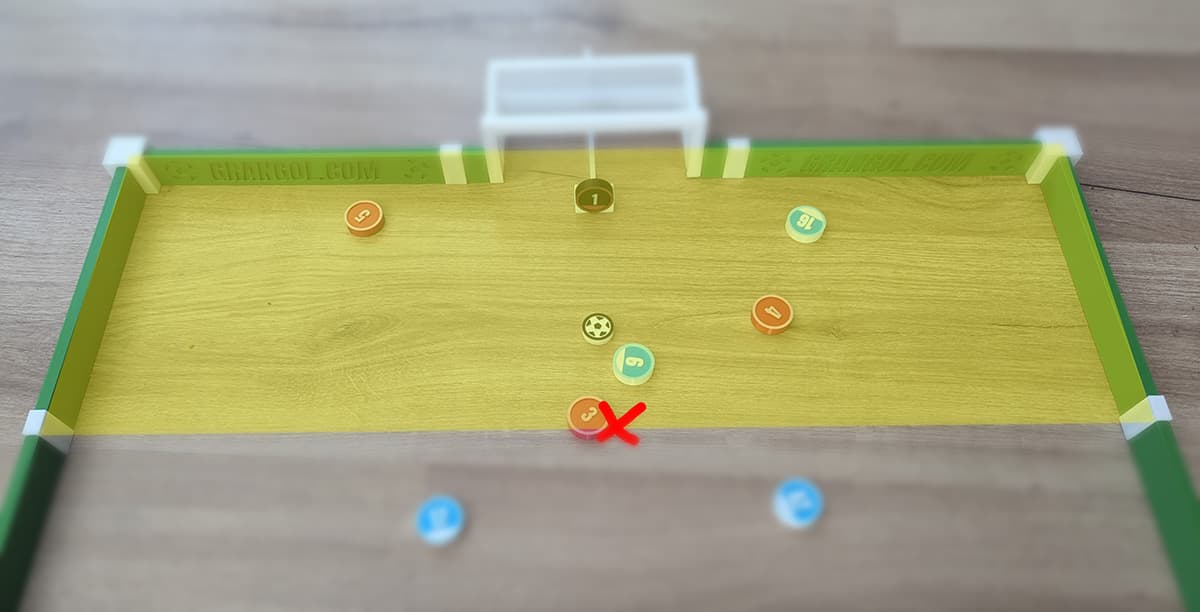
The length of the last side fence marks the penalty area. The shot is taken from the center.